Comparison
Wood Burning Tool vs Soldering Iron: Differences and When Each Works
Published
Short answer
Yes both ways, with limits. A soldering iron burns wood: irons run at about 200 to 480 C (392 to 896 F), the same range as a craft wood burning pen, but their plated tips are shaped for solder, not for drawing. A solid-point wood burning pen solders only with a soldering point fitted, and it cannot hold a set temperature. A wire-nib burner is not a soldering tool.
This page is for someone who owns one tool and wonders whether to buy the other. A solid-point wood burning pen is built like a soldering iron: a heating element in the barrel and a tip on the end. Colwood, a burner maker, calls the older solid tools soldering iron style. What separates the two is the tip metal and shape, how the tip is held, and how the heat is controlled. Those three things decide whether a swap gives a clean line, a sound solder joint or a ruined tip.
Wood burning pen vs soldering iron: side-by-side table
The table sets a solid-point pen and a wire-nib burner against a soldering iron. Temperatures are published figures for the tip in free air. A craft pen dial shows zones or numbers, not degrees, and every tip cools when it touches the work.
| Feature | Solid-point wood burning pen | Wire-nib burner | Soldering iron |
|---|---|---|---|
| Build | Element in the barrel, screw-in brass tip | Power unit with a dial, light pen, nichrome wire nib | Element in the barrel, plated copper tip |
| Published heat | 900 to 950 F (480 to 510 C) for fixed-heat craft pens | Up to 1000 to 1650 F, depending on the unit | About 200 to 480 C (392 to 896 F) |
| Heat control | None, or a dial with zones, not degrees | Numbered dial, not degrees | None on simple irons. A station sets and shows a temperature |
| Tip metal | Solid brass | Nichrome wire | Copper core plated with iron |
| Tip shapes | Universal, flow, cone, calligraphy, shading, stamps | Writing, ball, skew, spoon and spear shaders | Conical, chisel, bevel |
| How the tip fits | Threaded. Threads differ between brands | Nibs or whole pens swapped, per brand | Interchangeable bits, per iron model |
| Made for | Lines, lettering and tone on wood and leather | Fine detail and shading | Melting solder onto metal joints |
Is a wood burning pen the same as a soldering iron?
A solid-point pen and a simple soldering iron share the same build: mains power heats an element in the barrel, and the element heats the tip. Weller, a soldering iron maker, sells a 25 W woodburning kit, and fixed-heat craft pens are listed at 900 to 950 F (480 to 510 C). A soldering iron for electronics is usually 15 to 35 W and works at about 200 to 480 C (392 to 896 F), so the two overlap.
The difference is at the tip. Wood burning tips are solid brass, cut into shapes that make marks: a universal wedge, a rounded flow point, a shader. Soldering tips are a copper core plated with iron, made so that molten solder wets them, in conical, chisel and bevel shapes. A wire-nib burner is a different machine: a power unit sends current through a thin nichrome wire nib, which heats and cools quickly. The tip chart shows each shape and the mark it makes.
Can you wood burn with a soldering iron?
Yes. The published range of a soldering iron covers the low, medium and high heat bands used for pyrography, from about 400 F for a pale tan mark to 950 F for near black. A conical tip draws fine lines and dots much like a cone point, and the edge of a chisel tip gives a line like a calligraphy point. What an iron lacks is a shader, a flow point and stamps, so shading is slow and uneven.
A simple iron has one heat, so the tone is set by speed: the longer the tip stays in one place, the darker the burn. A soldering station with a temperature display is the exception, because it shows degrees, which no craft pen does. For lines on basswood start in the low to medium band, 400 to 750 F (200 to 400 C), and confirm on a scrap of the same wood. The temperature chart gives the band for 16 materials.
- Use a clean tip that has never carried solder. A tinned tip is coated with solder, and that coat does not belong on wood.
- Wipe carbon off on a damp sponge or brass shavings. Sandpaper is likely to damage the iron plating and expose the copper.
- Keep that tip for wood from then on. Carbon and oxide on a tip stop solder from wetting it.
- Burn only bare, untreated wood, with the smoke pulled away from your face: see is pyrography safe.
Can you use a wood burning tool for soldering?
A solid-point pen can solder if its kit includes a soldering point. Walnut Hollow's Creative Versa-Tool does: the instruction sheet lists a soldering point, used with the supplied lead-free solder (99.25% tin, 0.75% copper, rosin core) to join metal, and puts soldering in the hottest of its four dial zones. The sheet says to tin the point first: melt a little solder onto it and wipe the excess on a damp sponge. If residue builds up, rub the point on fine sandpaper and tin it again.
The limit is control. Solder melts at approximately 185 C (365 F), and lead-free solder needs more heat. A craft pen reaches up to 950 F (510 C) and shows zones, not degrees, while a soldering station holds the temperature you set. So the pen suits the craft joins the sheet describes: metal ends roughened with steel wool or sandpaper and joined with solder. A brass drawing tip is the wrong shape for solder, so use only the soldering point, and keep that point off wood.
A wire-nib burner is not for soldering. Walnut Hollow's wire-nib Creative Woodburner, for example, ships with drawing, shading and ball points and no soldering point.
Do wood burning tips fit a soldering iron?
Do not count on it. Solid wood burning tips screw in, and the threads are not universal even between pens: TRUArt states M4 x 0.7 for its tips and says they do not fit Walnut Hollow pens. Walnut Hollow and Weller publish no thread size. Soldering irons take their own interchangeable bits, and one design holds the tip in a tube clamped with a nut, with no thread on the tip at all.
So a set of brass tips fits a soldering iron only if the listing names that iron under "fits models". The thread and fit chart in are wood burning tips universal lists what each brand states.
Choose a wood burning tool when
A purpose-made pen is the better tool as soon as the work is more than a few rough lines. These are the cases where the soldering iron you own stops being enough.
- You want to shade. Shading points and spoon or spear shader nibs have no equivalent among soldering tips.
- You want lettering or cursive. Flow, ball and calligraphy tips make an even line in any direction.
- You want names and dates without freehand work. Letter and number stamps are solid wood burning tips.
- You need lower heat for soft wood or leather. A dial pen can be turned down, and a simple iron cannot.
- You want fine detail with fast heat changes. That is the job of a wire-nib burner.
Keep using the soldering iron you own when
The iron is enough for a trial, and it stays the right tool for its own job. The wood burning cases below assume a clean tip kept for wood only and bare, sanded wood.
- You want to try pyrography before buying a pen: a few outlines, dots and initials on a basswood scrap.
- Your iron is a station with a temperature display. You can set a figure inside a heat band, which a craft pen cannot do.
- The job is soldering. For electronics and any joint that needs a set temperature, use the iron, not a wood burning pen.
Quick answers
Short answers to the common swap questions. Temperatures are published figures, and a craft pen dial shows zones or numbers, not degrees.
- Is a wood burning pen the same as a soldering iron? A solid-point pen has the same build, an element in the barrel and a tip on the end. The tips differ: shaped brass for wood, plated copper for solder.
- Can you wood burn with a soldering iron? Yes, for simple lines and dots. Use a clean tip that has never carried solder, and control the tone with speed.
- Can you use a wood burning pen as a soldering iron? Only a solid-point pen with a soldering point, such as the one in the Walnut Hollow Creative Versa-Tool kit, and only for simple craft joins.
- Do wood burning tips fit a soldering iron? Only if the listing names your iron. Threads are not universal, and some irons clamp the tip instead of threading it.
What you need for this
 See price on AmazonAmazon
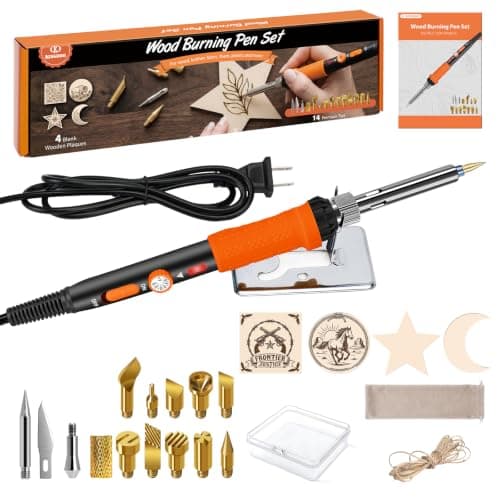
K KERNOWO 23-piece kit, dial 200-450 C, 14 tips
From Best Wood Burning Kit for Beginners: Starter Pens Compared
 See price on AmazonAmazon
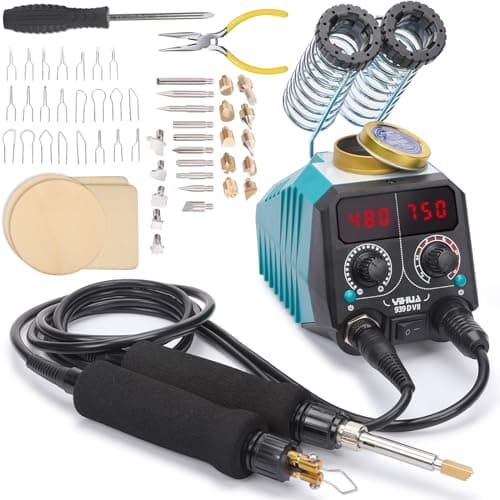
YIHUA 939D-VII 2-in-1 station, solid and wire pens
From Best Wood Burning Tools With Adjustable Temperature Control
 See price on AmazonAmazon
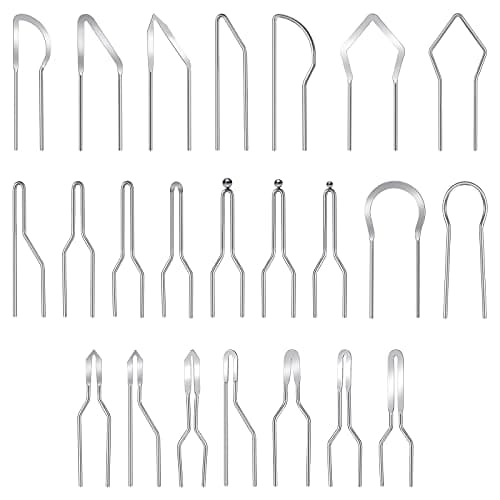
Outus pyrography wire nibs, 23 pieces, 23 shapes
From Best Wood Burning Tip Sets and Replacement Tips by Pen Type
 See price on AmazonAmazon
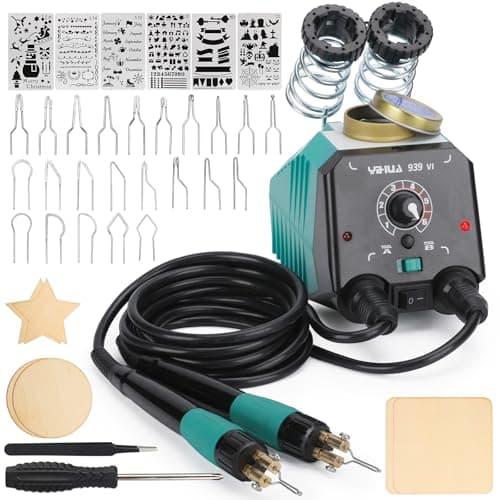
YIHUA 939-VI dual pen station, 23 wire nibs
From Best Wire Tip Wood Burners: Pyrography Machines Compared